Showing posts with label reading. Show all posts

Saturday, 24 April 2010

Paranormals whatever

Although I find publishers’ marketing trendiness for so-called paranormal/ supernatural romance books a vaguely interesting cross-genre project, I have avoided reading any of those novels… There are simply too many series of books, the market is obviously swamped, and I prefer TV adaptations of such things on DVD – amongst a batch of boxsets, I watched Blood Ties (based on Tanya Huff’s Vicki Nelson series), and I’m likely to be reviewing True Blood (derived from Charlaine Harris’ Sookie Stackhouse books) for Black Static, soon.   

My concern is whether such experimenting with varied tropes is any kind of genuine literary development or worthwhile genre progress..? By making traditional horror’s creatures (vampires and werewolves, especially) the heroes/ heroines or characters in modern romantic dramas, former subgenre menaces have lost much of their gothic appeal (Buffy has a lot to answer for), and such contemporary over-familiarity risks domesticating the monsters. What’s happening to essential otherness of horror in all this? Is ‘urban fantasy’ just another gimmicky category label for bookshops or does it represent horror tamed into mediocrity? 

Hopefully, new vampire anthology, The Bitten Word (Newcon Press) - which I bought at the World Horror Convention in Brighton, will contribute something… terrifying or fascinating to whatever’s the next big thing or movement for independent publishing. Back in 1985, Tom Holland’s comedy-drama Fright Night had a vampire moving in next door to a horror fanboy, and then kidnapping/ seducing a teenager’s girlfriend, but at least Fright Night’s vampire remained (mildly) scary. When horror abandons subversive traits, adopting/ favouring romantic plots instead, and ghastly monsters/ transforming creatures are domesticated, we get awfully boring soap opera/ sitcoms like TV series Being Human.

Is that sort of material a suitable advancement of meaningful horror for 21st century, in TV, film, or books?

Monday, 5 April 2010

Odyssey finale

Odyssey 2010 – Monday

Yesterday was busy, starting with a panel on anthologies – Ellen Datlow, Ian Whates, Colin Harvey and Gary Couzens discussing 'the art of compilation'. Al Reynolds' talk about 'SF and the modern cosmos' had tech problems, so it started late and its colour slide-show was only screened in black-and-white. From the main hall, I went to the noon panel about 'writing meaningful reviews' moderated by John Clute, but the panellists (I'd never heard of any of them before) all had completely different perspectives, making any balanced or interactive discussion rather difficult.

I had to leave that item early, to visit Green Room, ready for my panel about Clarke (and whether he's still worth reading), where Colin Harvey moderated our discussion. With Ian Whates, Edward James, Martin McGrath, and Stephen Gaskell, opinions differed but we seemed to agree that such older SF novels ought/ should appeal to younger readers today. After, I listened to some comments from 'Not The Clarke Awards' panel, but found I hadn't read any of the books they were talking about.

Next, meeting Interzone film reviewer Nick Lowe, after his BSFA lecture on “2001 and the Narratology of Transcendence,” revealing the 'untold' story about developing the script for Clarke and Kubrick's masterpiece. I saw Roy Gray just after the dealer's room closed at 6pm, and we went to the poetry readings hosted by Birmingham's former poet laureate Chris Morgan. Roz Kaveney's readings were good, as were some others, but I forgot their names.

I had to leave that room early, in time for my panel on James Cameron's Avatar, where Jetse de Vries moderated our lively discussion of the film's merits and faults. I waited patiently for the Mitch Benn gig to start - much later than expected in the main hall, but his 'adult' comedy/ singing act was not funny and only weakly amusing. I think he's just a retarded Bill Bailey wannabe.

Announcements made in Atrium bar space for 'Steampunk Ball' dance in the main hall were an increasing annoyance during late night drinking and chat, but it didn't really spoil the evening, where conversations included mysterious origins of life and the reportedly surprising popularity of Harry Harrison in Russia... I found a copy of Sentinel newsletter #5, with a picture of my first panel on Friday night. Oh, yay.

This morning, I'll be checking out, but still going to programme items, and I have one more panel to do before the closing ceremony.

Sunday, 4 April 2010

Odyssey weekend

Odyssey 2010 – Saturday & Sunday morning

After breakfast on second day of convention, I missed the panel on female superheroes, and went for educational and informative 'Quantum Computing For Beginners' talk by Dr Nik Whitehead, adding some background detail to theories I'd already read about in SF books. Found a front-row seat for guest-of-honour Iain M. Banks' highly amusing interview by Jane Killick, but I had to leave main hall early in time for my panel on Watchmen, debating film's merits & faults but also talking about Alan Moore, the motion comic, and superheroes in general.

George Hay lecture (sponsored by SF Foundation) was an interesting talk by Oliver Morton about 'geoegineering'. I enjoyed the panel on 'writers and the web' – including Joe Abercrombie and John Meaney moderated by Maura McHugh. Before teatime, I saw tail end of panel discussion on geoengineering, which included Phil Huggins, Jonathan Cowie, and Morton.

First hour of SF 'tall stories' inspired by Clarke's Tales From The White Hart was very good, with Andrew J. Wilson giving best reading of most entertaining short story, but I left after that one to get a drink... and found Jetse de Vries serving whiskies at launch party for his anthology Shine – which really deserves to succeed with its theme of optimistic SF. Slowly, the Royal room cleared to make way for an exclusive preview of short genre films chosen for Sci-Fi London Film Festival. I watched the first three but then had to hurry along to room 41, for my panel about US remakes of British TV shows, where versions of Life On Mars and The Prisoner were talked about.

After 10pm, I had something to eat from limited snack-menu in the Atrium bar, and was ready for drinking and talking until about half past one. Distribution of Odyssey's Sentinel newsletter seems uneven - I got issues two, three, four, but seven, but when/ where/ what happened to issues five and six?

Now it's after breakfast on Sunday... I'm especially looking forward to this morning's guest-of-honour talk by Alastair Reynolds, and my couple of panels about Arthur C. Clarke (lunchtime), and Avatar (this evening).

Friday, 26 March 2010

WHC 2010

World Horror Convention 2010

Arrived in Brighton early, quick journey via A27, easily found Royal Albion hotel on seafront. Parking hassles and rain spoilt Thursday's mood a bit, especially with having to wait for later check-in than we'd hoped... for top floor twin-room without any view. Had good feed at local chip shop, then went back to hotel in time for mid-afternoon panel item about zombies.

Opening ceremony (at teatime) was a packed out, standing room only, but we had front row seats. 'New Blood' was a panel with next generation of horror writers. Who Cares What You Think? - proved an interesting panel topic on reviewing for blogs. First day of drinking was rounded off with a couple of creepy new short stories, of great descriptive flair and subtlety, read by author Ramsey Campbell.

Friday started dry and windy during our seafront walk after breakfast. 'X Factor' offered retro movie reminiscences of panellists (both writers and artists). Tanith Lee was interviewed by Chelsea Quinn Yarbro, but I forgot to ask a question about her scripts for Blake's 7... 'Size Matters' was a worthwhile panel topic on current small press activities. Left reading by Brian Lumley after a few minutes because I found his story rather boring (too much arithmetic & fractions about vampire's age!), and went to see art show, where I met artist Caroline O'Neal and poet Cardinal Cox – both contributors to Premonitions.

I bought a couple of hardcover books at Newcon Press launch, and went to interesting 'Heritages of Horror' panel, featuring critics Kim Newman and David Pirie, talking about movie books. 'Life Sucks', a discussion of vampire fiction, was final panel of day for me.


Friday, 5 March 2010

Caterer

I read and greatly enjoyed Jeff Lint’s The Caterer comic (#3 ‘reprint’ by Floating World). Steve Aylett (steveaylett.com) continues to milk his phenomenal Lint mania. This perfectly ‘reproduces’ the format and printed medium of 1970s’ comics, complete with dodgy adverts and a ‘fan mail’ page. “Once again tatty curtains part on the true situation.”

When he’s not practising trademark ‘stillness’ with baffling diatribes, ‘hero’ of The Caterer, Jack Marsden, is causing untold mayhem and indulging his penchant for splash–page dreamscapes eerily reminiscent of Hieronymus Bosch. This is surreal comicbook weirdness at it most deliriously offbeat, so utterly irreverent that Aylett risks losing as many readers as he’s likely to gain.

Newly minted pulp action scenes vie for attention with inconveniently preposterous dialogues and supporting characters - like (or perhaps you don’t?) Sheriff Leonard Bayard that help define friable Jack by doing things he doesn’t, such as leaning, or giving moderately sane advice (“don’t let it be udders”). But, whatever else we think of Jack, in The Caterer, we’re bound to wonder “what he’s doing now” and what he’s going to do next…

Further cause for celebration, is a new revised edition of Aylett’s implacably amusing Inflatable Volunteer.

Wednesday, 13 January 2010

Interzone in colour


Issue #226 of Interzone (published by T3A Press) marks the great magazine's return to printing in full-colour, throughout, something not seen in these pages since #211 (July-August 2007). It certainly does brighten up the non-fiction sections and adds visual impact to the artwork produced for some of the stories. And, in future, I hope that artists illustrating new genre fiction will take advantage of this upgrade - a very positive change - in the overall quality of IZ.

My blu-ray and DVD column, 'Laser Fodder', in this issue has review coverage of District 13: Ultimatum, Godzilla, Year One, Starhyke, Bronx Warriors trilogy (of 1990: Bronx Warriors, Escape From The Bronx, New Barbarians), Moon, District 9, Misfits, Final Destination 3D, plus a round-up of Star Trek (2009), Terminator Salvation, Terminator: The Sarah Connor Chronicles: season 2, Transformers: Revenge Of The Fallen, and G.I. Joe: The Rise Of Cobra.

Friday, 11 December 2009

Journeys


The 13th issue of Midnight Street magazine includes my overview article about several films based on Jules Verne's Journey To The Centre Of The Earth.

My reviews include the well-known 1959 adaptation, the Spanish production Viaje al Centro de la Tierra, the recent 3D version, and TV stuff.

This is the last printed issue of Midnight Street, but the 'journeys into darkness' will continue with electronic publication as PDF download. For more info and news about subscriptions or submissions, visit the publisher's website at www.midnightstreet.co.uk.

Thursday, 12 November 2009

IZ #224 reviewed

Excerpt from a review of Interzone #224

My favorite non-fiction section would have to be the movie and TV reviews by Nick Lowe and Tony Lee. Both are phenomenal at making reviews entertaining. They’re not just reviews, but little stories told through criticism. Both Lowe and Lee have unique review styles and I had a lot of fun reading through their biting remarks. I can’t say this is true of any other review section in any magazine. I rarely read the reviews in Realms of Fantasy or Analog (or any others I happen to get from time to time), but I know that I will always go to this section first when reading Interzone.


Read the full review at Fantasy & SciFi Lovin' News & Reviews.

Tuesday, 29 September 2009

Celebration


Celebration
- 50 years of the British Science Fiction Association
editor: Ian Whates
newconpress.co.uk

A solid but sadly unexceptional collection, with stories that range from whimsical surrealism and cranky genre satire to uniquely British retro and speculative fiction reflecting (via alternate worlds) on familiar 20th century SF tropes or delivering riffs on edgier 21st century themes. It's a book that's quite suitable for collectors of SF literature but is hardly essential reading for general sci-fi fans.

Tuesday, 25 August 2009

Horror in 2008...


Here's a quote from page 38 of editor Stephen Jones’ introduction to The Mammoth Book Of Best New Horror 20th anniversary edition (Robinson)...

"After an uneven start with its first two issues, Andy Cox’s Black Static finally began to find its own identity...
Although it did not reach the standard of The 3rd Alternative... the magazine presented some impressive short fiction...
However, the periodical’s best bits remained the regular columns by Christopher Fowler, Stephen Volk, Mike O’Driscoll, Peter Tennant and, especially, Tony Lee’s insightful DVD reviews.

Lee also provided DVD reviews to Black Static’s attractive sister publication, Interzone."

Very chuffed - but, oh dear! I’m going to be unbearably smug this afternoon, and probably for the rest of this week...

Monday, 29 June 2009

Fantastique


Got #1 of first English version of the long-running L'Ecran Fantastique... www.ecranfantastique.net, which offers a choice of Terminators or Transformers cover.

It's a large format (nearly 9x12 inches) and 100 pages, with guest columnists (like Jon Gulager), previews of Emmerich's 2012, and Argento's Giallo, coverage of My Bloody Valentine 3D, plus DVDs, cult stuff and other fanzine-stye features.

A breakthrough in publishing history, or just a replacement for Starburst and Shivers in the crowded media-zine marketplace?

Thursday, 20 March 2008

Clarke RIP

Arthur C. Clarke was one of 20th century literature's three giants of science fiction. (The other two were Isaac Asimov and Robert A. Heinlein.) Clarke died, at the grand age of 90, on Wednesday 19th March (though news reached UK while it was still Tuesday) and it's a very saddening thought for genre fans reflecting on how the author of classic novels - like 2001: A Space Odyssey, and Childhood's End, produced such powerfully imaginative books that he was largely responsible for introducing them to SF in the first place, and making his readers life-long fans and followers of the genre's unique sense-of-wonder. (When I was a kid, it was Clarke's Earthlight which got me hooked on reading SF!)

When reading (and reviewing for Starburst #171), Odyssey, Neil McAleer's authorised biography of Clarke, I noted that it presented an essentially positive view of Clarke, without any muck-raking (Clarke's autobiography Astounding Days paints a similarly rosy picture), but that did not - and still doesn't - suggest that any negative comments were due, anyway. And it's worth remembering it was Clarke who attained a "cosmic eloquence" in his SF books and lectures that still remains unequalled in the field and the genre canon. With that in mind, I think that any number of human flaws and character faults should be overlooked. Clarke's single-volume Collected Stories is a treasure house of imaginative SF lore and it's changing focus over decades, and it reveals much about the genre's development as fantastic literature.

I've always found it fascinating to compare the film 2001 with the novel version, one being a genuine work of art by Stanley Kubrick (see here), and the other being a kind of distillation of Clarke's views on some of the big questions (about life-as-we-know-it, the ever-surprising universe, and everything..?), some of which remain unanswered in 21st century. Although it's obviously a great shame that so little of Clarke's boundless optimism has survived the various social changes of the millennium, there can be no doubt that his visionary input into SF is a vital guiding light as we lurch towards whatever future state (or complete mess?) the world gets into next.

Monday, 15 May 2006

Interzone weekend

Having purposely let my BSFA membership lapse, I decided the money saved had to go elsewhere, anyway, but perhaps it could be spent more wisely. None of the other offers I glanced at online looked as tempting as a backdated subscription to Interzone, and my first bumper fun pack of five issues arrived swiftly. Despite being told via email that IZ #200 had sold out, the helpful staff at TTA Press managed to filch one from a shadowy parallel world and, happily, that milestone edition was included in my chosen batch of back numbers.

So slickly designed you can hardly get a handle on it nowadays, this all-singing all-dancing genre magazine for thinking SF readers has evolved to meet the marketing challenges of 21st century newsstand publishing. IZ chief Andy Cox is not to be confused with a 'zine editor who's only going through the motions. With an uncompromising determination to raise production standards and a gleeful disregard for the stuffy traditions of the last century's bi-monthly serials, "Britain's longest running science fiction magazine" today sports eye-popping colour throughout and has frequently dazzling layouts, so its overall presentation is seldom less than stunning, boasting visuals from a parade of talented artists - including Jesse Speak, 'Glitchwerk', Vincent Chong, David Senecal, Ian Simmons, and the great Rik Rawling.

Despite its occasional pomposity and relentlessly camp poeticising of answers to Michael Lohr's usually straightforward questions, I enjoyed IZ #200's generally waffle-free interview with Richard Calder, a genuinely eccentric literary stylist of impeccable pedigree whose post-cyberpunk trilogy (Dead Girls/ Boys/ Things) was - for me - one of the brightest events in SF publishing during the early to mid-1990s. Calder's fiction presides over subsequent issues of IZ with the awesome delirium of his novella After The Party sprawling across #201 to #203, shoving aside - but not without a mighty effort - even top-notch material from Paul Di Filippo, Elizabeth Bear's paired stories Wax and Wane, Jay Lake's gloomy The American Dead, and Among The Living by Karen D. Fishler (weirdly, Fishler's story is illustrated by Chris Nurse... and Fishler is dead ringer for a nurse I used to know named Christine).

All that said, and nonfiction aside, the best slice of SF entertainment in #200 is, predictably enough, from Rudy Rucker (author of madcap idea-fest, Saucer Wisdom). Guadalupe And Hieronymus Bosch tells of an unlikely romantic encounter - between a 21st century American woman and Bosch himself, that whimsically redraws the whole socio-cultural map in devastating dreamscape fashion. Of course, this being a Rucker tale, the meeting that so casually knocks the home universe completely out of whack is actually enabled by a shape-shifting, cosmos-surfing, meddlesome trickster-alien. It's an instant classic of the cheesy-but-fun variety!

For #202 and #203 the page count zooms up to 80 pages (at no extra cost), yet all the editorial experimentation of recent months has settled down a bit now, and the magazine somehow feels crash-dieted rather than super-sized. I confess that some of the fiction in IZ just couldn't hold my interest beyond a first paragraph, let alone a whole column or two. With no regrets, I neglected to finish the likes of Sundowner Sheila by F. Gwynplaine MacIntyre, and Joseph Paul Haines' Ten With A Flag. Well, it's simply clunky dialogues, uninspired intros, or pointlessly arty aesthetics that puts me off sometimes, or perhaps an indefinable combo of unappealing abstracts and overly familiar notions. Whatever... Probably the best story in #202 is Jack Mangan's The Unsolvable Deathtrap, delivering automotive terror with a ghastly Billy Joel soundtrack. Apart from the Lake and Bear stories, I thought #203 was largely below par. A tougher read than it ought to have been. Scattering the 32 vignettes of Di Filippo's unwieldy-titled 'Furthest Schorr...' across umpteen pages might not have been very clever, I'd say. Calder's livewire 'nymphomaniad' opus reaches its broodingly pink-skied close. Calder also brings heavyweight insight to the nonfiction, interviewing Etched City author K.J. Bishop (who contributed one of the better pieces to Andrew Hook's quirky Alsiso Project anthology).

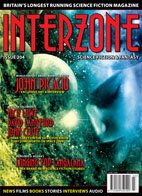
The latest IZ is #204. The opener serves up a fascinating interview (by Steve Badrich) with award-winning cover artist John Picacio, who seems a bit surprised by the observation of 'transformation' themes in his work. The first story, Longing For Langalana by Mercurio D. Rivera, had me yawning (well, I was tired after a spot of DIY woodwork) after page one, so I flipped on to Tim Akers' haunting The Song, concerning obsessed musician, Jack. Like Glenn Miller, Jack struggles to capture a unique sound. When he finally succeeds, however, the result is something quite unexpected for Jack, but fairly predictable to me. I thought the nude-cyborg art by Ales Horak was cool, but simply couldn't get interested in the story that it illustrates, The Rising Tide by someone named C.A.L. (Personally, I think that kind of byline is dreadfully pretentious.) Summer's End by Jamie Barras benefits from the impact of Marcel Blazejczyk's full-page art, a ziggurat emerging from twisted stone, but it's a shame the mediocre story owes so much to Pohl's memorable 1970s' shocker We Purchased People. Martin Gidron's Palestina has an engaging alternative-history premise featuring a sharply etched sense of place but, as with the majority of such timeline japes, it depends entirely upon offbeat-narrative twists and a shameless punchline for its effect.

The final story in IZ #204, James White Award winner A Short History Of The Dream Library by Elizabeth Hopkinson, gets my vote for the best piece of fiction this issue. Here's the rebellious alt-history for today's Britain. Hopkinson demonstrates a fizzy, eccentric imagination, and plenty of nimble wit. Hilariously satirical, brilliantly concise, and worth the price of admission alone, this story is so bloody funny you'll probably still be chuckling hysterically in your sleep. Let's see more from this amazing writer, please!

Of this magazine's regular nonfiction section (which toplines John Clute's column on books), Nick Lowe's Mutant Popcorn deserves a special plug, if only because I hardly ever agree with his film reviews! Almost perversely, Mr Lowe tends to favour everything (Spielberg's War Of The Worlds, Fantastic Four, Disney's Sky High, Nausicaa, Alien Autopsy) that I typically dislike about sci-fi cinema, and unfairly derides blatantly-subgenre movies (like Wallace & Gromit, Serenity, Doom and V For Vendetta), which I find particularly good, albeit for widely differing reasons. So it came as a relief to note that we had, at least, similar opinions about intriguing no-budget oddity Primer and Gilliam's sadly disappointing The Brothers Grimm. Lowe is a very good writer, of course, but, normally, I find his taste in SF films is appalling.